
You Just Earned Your A-License. Now What?
The progression card disappears after your A-License. Here's your complete guide to all 5 requirements—what they are, how to approach them strategically, and how to complete your B-License in 4-6 months.
Download the Complete Checklist ->
Your 3-Step Path to a USPA B-License
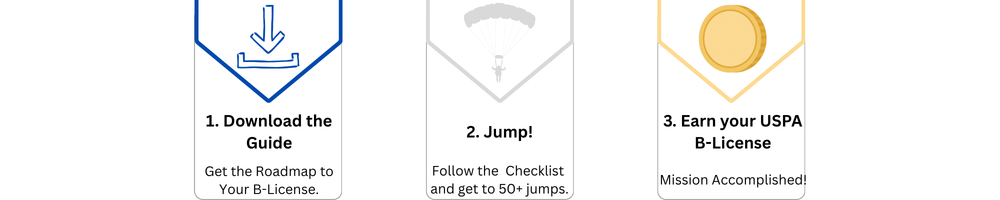
After earning your A-license, many skydivers face a challenge they don't anticipate: the structure disappears.
Your AFF progression card gave you clear objectives for every category. You knew exactly what skills to demonstrate and what came next. After your A-license? That clarity vanishes.
Many jumpers drift without a plan, making fun jumps that don't build toward anything specific, taking 12 or more months to complete requirements that could be done in 4-6 months with a strategic approach.
The B-License Requirements
To earn your B-license, you must complete seven requirements:
You have 25 or more jumps remaining after your A-license to complete the other requirements.
Accumulated across your jump log. Most skydivers complete this naturally as they build jump numbers.
Complete all requirements listed on the USPA B-License Canopy Proficiency Card. Requires sign-off from a USPA S&TA or Examiner.
Live water-landing training with full equipment per the Skydiver's Information Manual. May be offered standalone or bundled with canopy training.
Land within 33 feet (10 meters) of target center on 10 jumps. Half the distance of your A-license requirement.
RW or freefly. At least 5 must include 3 or more participants in the formation.
Online exam covering BSRs, equipment, emergency procedures, and canopy flight. Must be administered by a current USPA Instructor, S&TA, Examiner, Judge, or board member.
Realistic timeline: at 4-7 jumps per month, most skydivers complete their B-license in 4-6 months after their A-license.
Get the Complete B-License Roadmap
A 7-page strategic guide to completing your B-license in 4-6 months, including a progress tracking checklist for every requirement.
- Requirement-by-requirement strategy and timing
- The most common mistakes that slow progression
- Complete progress checklist with date and jump number tracking
- Budget planning and realistic cost breakdown
Created by Experienced USPA Examiners
AFF Instructor
Jumping since 2001
AFF Instructor · FAA Senior Rigger
Jumping since 2001