
The Mental Rehearsal Technique Most Skydivers Ignore (But Shouldn't)
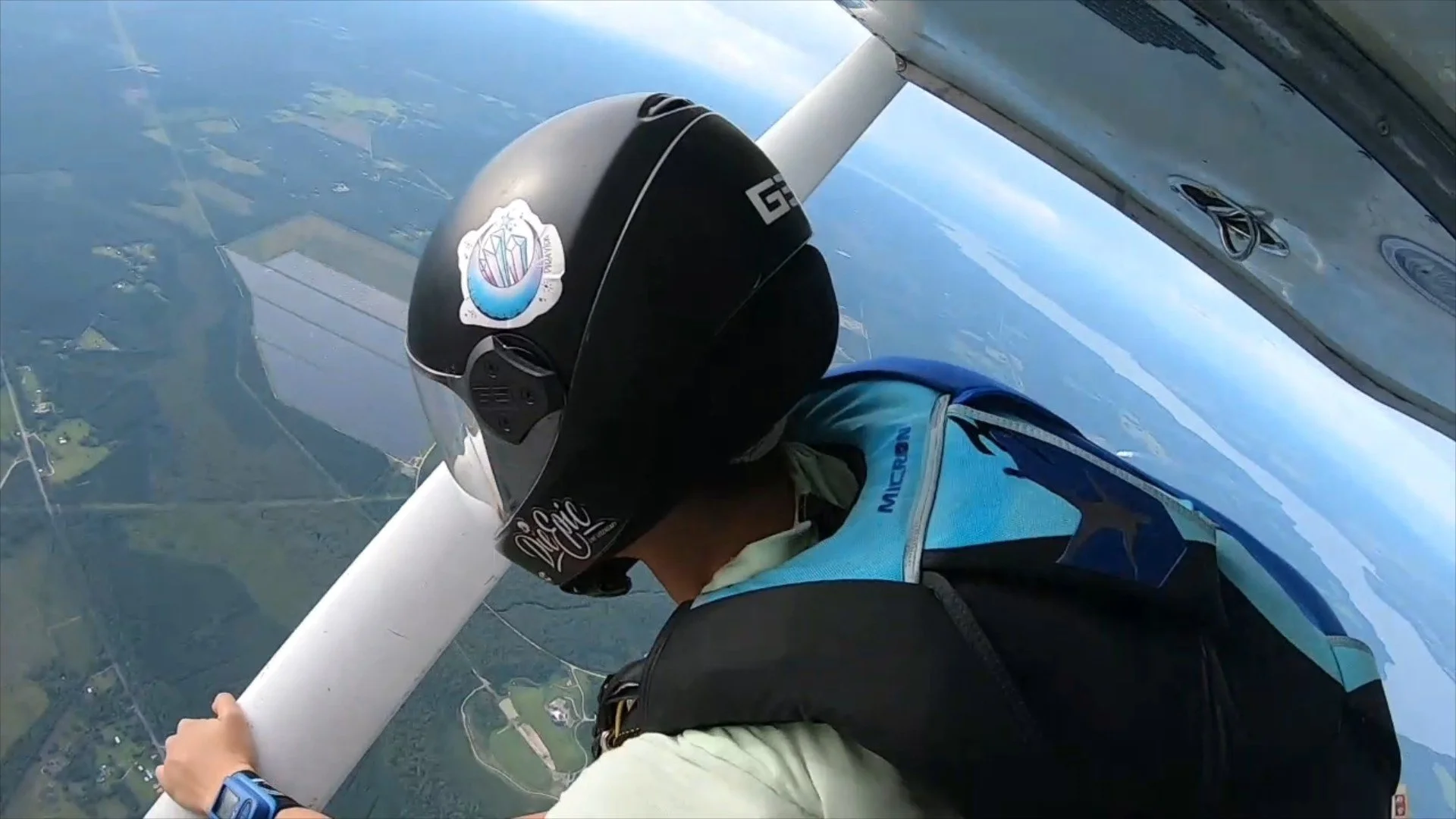
You've nailed your practice pulls on the ground. Your instructor has watched you demonstrate perfect body position in the mock-up door. You know the dive flow by heart. But the moment you exit the aircraft at 13,000 feet, your mind goes blank and your body freezes.
Sound familiar?
Here's the thing: everyone focuses on physical practice, but most skydivers completely ignore mental rehearsal. Yet this is exactly what separates consistent performers from those who struggle with the same skills jump after jump.
If you've ever wondered why you can execute perfectly on the ground but fall apart in the air, the gap isn't always physical—it's mental preparation.
What Experienced Skydivers Already Know
Many experienced skydivers already use visualization, whether they realize it or not. If you've ever watched formation skydivers do a "dirt dive" before a jump, you've seen mental rehearsal in action. They walk through the formation on the ground, then they mentally rehearse it again—visualizing each transition, each grip, each movement.
But here's what most people miss: they're not just doing this on the ground. In the aircraft, on the way to altitude, they're running through it again in their minds. If it works for complex 20-way formations where timing needs to be perfect and 20 people need to be coordinated, imagine what it could do for your AFF progression or canopy skills.
The science backs this up. Research in sports psychology has shown that mental rehearsal activates the same neural pathways in your brain as physically performing an action. In a landmark 1995 study published in the Journal of Neurophysiology, researchers found that piano players who only mentally rehearsed showed nearly the same neural growth in their motor cortices as those who physically practiced. Your brain doesn't fully distinguish between real and vividly imagined experiences—which means proper visualization can literally improve your performance without you ever leaving the ground.

The Two-Part Visualization Method
There are two critical components to effective mental rehearsal for skydiving, and most people only do the first one (if they do any at all).
Part 1: The Perfect Jump
This is the one most people think of when they hear "visualization." You imagine yourself executing the skill perfectly—smooth exit, stable body position, clean pull, on-heading opening, perfect pattern, smooth landing.
Why it works:
When you repeatedly visualize performing a skill correctly, you're building neural pathways and muscle memory even when you're not physically jumping. Keith Begley, an accredited performance psychology consultant with the Sport Ireland Institute who has worked with Olympic-level athletes, explains that this type of mental skills training strengthens the brain-body connection that facilitates actual performance.
You're also building confidence. The more times you "see" yourself succeeding, the more your brain believes success is not just possible, but likely.
How to do it - Engage ALL your senses:
This is where most people get it wrong. Effective visualization isn't just about "seeing" yourself do the jump in your mind. You need to engage as many senses as possible to make the experience as realistic as you can.
Olympic freestyle skier Emily Cook described her visualization process this way: "Visualization, for me, has to take in all the senses. You have to smell it. You have to hear it. You have to feel it, everything." She would record herself saying, "I'm standing on the top of the hill. I can feel the wind on the back of my neck. I can hear the crowd," going through every sense and every step of the perfect performance.
Here's what that actually looks like in the skydiving world:
Feel: The vibration of the aircraft seat as you climb to altitude. The pressure of your harness when you stand up in the door. The blast of cold air hitting your face as you exit. Your body position in freefall—the slight tension in your legs, the arch in your back, the air pressure on your arms. The jolt of your parachute opening. The toggle pressure in your hands during your pattern.
Hear: The aircraft engine roaring as you climb. The rush of wind in freefall. The sound of your canopy deploying. The quieter whoosh of air under an open parachute.
See: Your altimeter at 13,000 feet. The horizon as you exit. Your instructor's hand signals. The ground getting closer. Your landing area approaching.
Smell: This is admittedly the hardest sense to incorporate in skydiving, but the smell of jet fuel as you approach the aircraft is real and can anchor your mental rehearsal.
Physical sensations: Your breathing rhythm. The adrenaline in your chest. The butterflies in your stomach before exit. The feeling of control when everything goes right.
When to practice it:
The best time is right before you go to sleep and right when you wake up—your brain is most receptive to this kind of programming during these times. Michael Phelps, the most decorated Olympian of all time, was instructed by his coach to watch a "mental videotape" of his races every night before bed and every morning when he woke up.
But you can also do it:
The night before your jump
In the aircraft on the way to altitude (like formation skydivers do)
Any quiet moment when you can focus for 5-10 minutes
Example scenario for AFF Category D students:
Imagine that you're standing in the door of the aircraft at 13,000 feet. The engine noise is loud and other jumpers are watching you, waiting for you to exit. Your instructor is on your left, their hand firm on your harness. The cold air blasts your face. You look out at the horizon, take a deep breath, and start the exit count, "Ready, set, GO!"
You step off the plane and push your pelvis forward, immediately feeling the freefall position your body knows—arch strong, legs slightly extended, arms in that "goalpost" position, yet relaxed. The roar of the wind is slightly muffled by your helmet. You check your altimeter: 12,000 feet. You're stable. You look ahead and pick your heading reference point on the horizon—a specific landmark, something distinct. You lock it in your mind.
Now it's time for your first turn. You initiate the turn by dipping your left shoulder as you keep your eyes on that new reference point. You feel your body begin to rotate. As your new heading starts to come into view, you return to neutral position and coast—your body momentum carrying you around. Just before you're perfectly aligned with your target, you give a slight counter-input with your right shoulder to stop the turn. Clean. Controlled.
You check your altimeter: 9,000 feet. Time for another turn. You pick a new reference point. Right shoulder dips, head turns right, you rotate, coast to neutral, counter to stop. Perfect.
You practice more turns—left, right, smooth and controlled—until your altimeter reads 6,000 feet. Time to prepare for pull. At 5,000 feet you wave off, sweeping your arms above your head to let other jumpers know you are about to deploy. You reach back, grip the pilot chute firmly, and throw it into the clean air with confidence.
You feel the familiar tug, then the opening—on-heading, smooth. Your canopy is overhead, fully inflated and flying beautifully. You grab your rear risers and use them to turn towards your holding area. Then you see that your altimeter reads 4,500 feet. Plenty of altitude for your canopy drills.
Now for the rear riser practice. You reach up and grab your rear risers, feeling the webbing in your hands. You pull down gently on the left rear riser. The canopy turns left, but it feels different from toggle turns—the riser pressure is higher, yet the canopy turns flatter. You release and the canopy levels out. Now the right rear riser. Pull down, the canopy banks right smoothly, release.
You practice a few more rear riser turns, getting comfortable with the pressure and response. Then you return to your toggles and set up your landing pattern. You did it—turns in freefall, rear riser drills, everything exactly as planned.

Part 2: The Problem Jump (This is the One You're Probably Skipping)
Here's where most people get uncomfortable: visualizing things going wrong.
Why most people skip this:
It's scary. It feels counterintuitive. Why would you imagine problems? Won't that make you more likely to have them?
Why it's actually MORE important:
Because problems happen. And if you've never mentally rehearsed how you'd handle an unstable exit, or an off-heading opening, or traffic in the pattern, your brain defaults to panic when these situations occur in real life.
Experienced skydivers visualize "what if" scenarios too. Formation skydivers imagine what they'd do if the exit timing is wrong. Instructors visualize what to do if a student becomes unstable during a jump or forgets to check their altitude. They're not inviting problems—they're preparing solutions.
Research shows that mental rehearsal allows you to pre-program a more productive reaction to challenges. When your brain has already "experienced" solving a problem in visualization, you're much more likely to stay calm and execute the correct response when it happens for real.
How to do it with full sensory detail + problem solving:
You use the same multi-sensory approach, but now you're adding the problem and—crucially—the solution.
Visualize the problem: You're in freefall and suddenly you start spinning. Your body is rotating uncontrollably.
Feel your body's response: You notice the initial tension, the slight panic starting to creep in.
Hear your internal dialogue: "I've got this. Check my altitude—I'm safe. Arch. Push my legs out slightly. Relax."
See the solution unfold: You check your altimeter—plenty of altitude. Your body responds to your corrections. You arch harder, extend your legs slightly, and consciously relax your muscles. The spin slows. You stabilize. Your instructor gives you a thumbs up.
Feel the relief and confidence: You handled it. You didn't freeze. You solved the problem.
Example scenarios to practice:
Unstable exit: You imagine yourself going head-low on exit, then correcting by arching harder and bringing your hips forward until you're stable again.
Off-heading opening: You visualize your parachute opening 90 degrees off heading, then calmly executing your controllability check, identifying which way to turn, and getting back on course.
Traffic in the pattern: You see another jumper below you in your landing pattern. You visualize yourself spotting them early, making a calm decision to extend your downwind or do a 360, and setting up for a safe landing with plenty of separation.
The key is always visualizing both the problem AND your successful solution. You're training your brain to respond, not to panic.
The Critical Line: When Visualization Becomes Obsessing
Here's something important that doesn't get talked about enough: there's a line between helpful visualization and harmful obsessing.
When visualization helps:
It's structured and time-limited (5-15 minutes)
You're actively rehearsing solutions, not just worrying
It builds your confidence and sense of control
You do it as part of a deliberate preparation routine
When it becomes obsessing:
You're running through endless "what if" scenarios for hours
You're catastrophizing—imagining the worst possible outcomes with no solutions
You're ruminating right up until you jump, increasing your anxiety
You can't stop thinking about all the things that could go wrong
It's making you more nervous, not more prepared
How to know the difference:
Ask yourself: "Is this mental rehearsal making me feel more prepared and confident, or more anxious and overwhelmed?"
If you find yourself spiraling into worst-case scenarios without solutions, that's not visualization—that's anxiety. And it's time to stop.
What to do instead:
Set a time limit: Spend 5-10 minutes on structured visualization, then move on with your day.
Always include the solution: If you visualize a problem, immediately visualize yourself solving it successfully.
Trust your training: At some point, you need to stop rehearsing and trust that your training will kick in. Your instructors wouldn't clear you for the jump if you weren't ready.
Focus on process, not perfection: Visualize yourself executing the steps correctly, not achieving some perfect, flawless jump. Skydiving isn't about perfection—it's about safe execution and continuous improvement.
For students especially, this distinction is crucial. If you notice yourself obsessing, take a step back. Do one final 5-minute visualization focused on confidence and trust, then let it go.
Practical Application: Your Structured Visualization Routine
Here's how to incorporate mental rehearsal into your skydiving preparation without letting it take over your life:
The Night Before:
10 minutes before bed: Visualize the perfect jump with full sensory detail
Focus on confidence and smooth execution
End with the feeling of a successful landing and the satisfaction of accomplishing your goal
The Morning Of:
5 minutes after waking: Quick mental run-through of the dive flow
Visualize one or two potential challenges and your calm, effective responses
Finish with confidence and trust in your preparation
Before Boarding the Aircraft:
After your gear check is complete: 2-3 minutes of brief visualization of your exit and first few seconds of freefall
This is about priming, not perfecting
In the Aircraft:
On the way to altitude: Run through the dive flow one final time
Keep it brief—this is reinforcement, not practice
When you're 5 minutes from exit, stop visualizing and focus on the present moment
Total time investment: 20-30 minutes spread across your jump day. That's it.
Once you've earned your A-License, visualization becomes even more valuable as you work toward your B, C, and D licenses.
Start Small, Build Gradually
If you've never done mental rehearsal before, don't try to implement this entire system tomorrow. Start with one thing:
Tonight, spend 5 minutes before bed visualizing your next jump. Engage your senses. Feel the experience. See yourself succeeding.
That's it.
Once that becomes comfortable, add the morning visualization. Then add the problem-solving component. Build it gradually.
Mental rehearsal is a skill like any other—it gets better with practice.
The Bottom Line
Your performance gap isn't always physical. Often, it's mental preparation.
Formation skydivers have known this for decades. Olympic athletes have been using these techniques for generations. The science is clear: mental rehearsal works because your brain doesn't fully distinguish between vivid imagination and real experience.
So why would you leave this tool on the table?
You wouldn't show up for an AFF jump without getting dressed or doing your gear checks. Mental rehearsal deserves the same priority in your preparation routine.
The sky is waiting. And now, so is your mind.
Ready to Take Your Training to the Next Level?
Mental preparation is just one piece of becoming a safer, more skilled skydiver. If you're working through your AFF progression, we've created a comprehensive free guide to help you succeed:
Download the Free AFF Preparedness Guide - Everything you need to know to prepare mentally and physically for your AFF jumps, including checklists, safety considerations, and key skills for each category.
Working towards your next license? Visit our USPA Licenses hub for a breakdown of all the requirements, tips, and resources that we have for each.
This guide will help you approach each jump with confidence and clarity.
Sources and Further Reading:
Begley, K. (Performance Psychology Consultant, Sport Ireland Institute). Applied Sport and Exercise Psychology. Published research in Journal of Applied Sport Psychology on attentional focus and mental skills training.
Pascual-Leone, A., et al. (1995). "Modulation of muscle responses evoked by transcranial magnetic stimulation during the acquisition of new fine motor skills." Journal of Neurophysiology, 74(3), 1037-1045.
Bandura, A. (1977). Self-efficacy: Toward a unifying theory of behavioral change. Psychological Review, 84(2), 191-215.
Association for Applied Sport Psychology. "Sport Imagery Training." https://appliedsportpsych.org/resources/resources-for-athletes/sport-imagery-training/
Have questions about visualization or mental preparation for skydiving? Contact us or connect with us on Instagram or Facebook