

Runway Headings for Skydivers: Read Winds & Plan Your Landing Pattern
Most jumpers land at their home dropzone dozens of times before they ever notice the numbers painted on the runway. Fewer realize that wind speed and direction can change completely between the ground and altitude, which is why the app that gave you a perfect landing pattern yesterday can leave you scrambling today.
This guide covers both pieces: how to read runway headings so you can orient yourself at any dropzone, and how winds aloft forecasts are built so you know when to trust them and when to treat them as a starting point.
📋 Note: As of the 2025 USPA Skydiver's Information Manual (SIM) revision, runway heading interpretation (previously part of Category B) is no longer a required topic for A-License certification. We still think it's worth knowing for situational awareness, wind assessment, and safe operations at any dropzone, which is why we continue to teach it.
Quick Navigation
Why This Matters to Skydivers
A lot of us are using apps to plan our landing patterns and exit spots. That's normal, but it's also why we get caught off guard when the app gets it right one day and puts us far from our target the next. The numbers those apps use come from somewhere, and understanding where helps you know when to trust them.
Instant Orientation
Read the numbers painted on the runway and you know your cardinal directions at any dropzone, without a compass.
A Way to Check Your App
When you understand how the winds aloft forecast is built, you know why it sometimes doesn't match what you're actually experiencing in the air.
Aircraft Awareness
Knowing the active runway and typical traffic pattern helps you anticipate where planes will be while you're under canopy.
How to Read Runway Headings
At any airport with paved runways, you'll notice large numbers painted at each end. These numbers correspond directly to the magnetic compass heading of that runway.
Identifying Runways vs. Taxiways: One easy way to distinguish runways from taxiways is that runways are the only paved surfaces with numbers and heading markings. Taxiways use letters (A, B, C, etc.) and yellow centerlines, while runways have white markings and the distinctive two-digit numbers.
Compass Basics Refresher
- North: 0° or 360°
- East: 90°
- South: 180°
- West: 270°
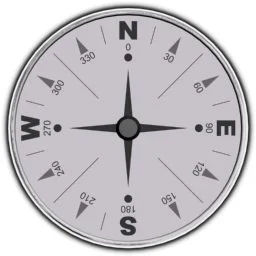
Cardinal directions on a magnetic compass. Runway headings use these same degrees.
The Two-Digit System
Runways are named for their magnetic compass heading, rounded to the nearest 10 degrees. Only two digits are used (01 to 36), following International Civil Aviation Organization (ICAO) rules.
Example: A runway heading 260° magnetic = Runway 26
Why Runways Have Two Numbers
Every runway can be used in two directions, so each end has its own designation. These two numbers will always differ by exactly 18 (representing 180 degrees, the opposite direction).
Example:
- One end heading 40° = Runway 04
- Opposite end heading 220° (40° + 180° = 220°) = Runway 22
- 22 - 04 = 18 ✓
Real Example: Skydive Sebastian
Skydive Sebastian is a useful example because it has two runways, which means there's an actual decision to make about which one is active, not just a number to read.
Satellite view of Sebastian Municipal Airport (X26), home of Skydive Sebastian. Runways 10-28 and 5-23 both visible from above.
Runway 10-28
- Runway 10: 100°, roughly east
- Runway 28: 280°, roughly west
Runway 5-23
- Runway 5: roughly northeast
- Runway 23: roughly southwest
Finding the active runway: Pilots generally take off and land facing into the wind. It reduces ground speed and generates more lift. So if you know which way the wind is coming from on the ground, you have a good idea which runway is active, and you can confirm it by watching a few aircraft. That's the actual skill: not memorizing which end is which, but using wind direction to figure out what's in use right now.
This applies at any dropzone, including smaller fields like Kay Larkin, one of the DZs near us. The mechanics don't change just because the airport is less well known. Mile-Hi Skydiving, shown in the video below, has a single runway (11/29), so there's no active-runway decision to make there. It's a good second example for a different reason: using a runway's known length as a rough distance reference, which comes up below.
Reading the Winds Aloft Forecast
Where the Data Comes From
NOAA collects wind and weather data from radar, weather buoys, pilot reports, satellites, and weather balloons launched twice a day around the world. That data feeds into weather models that generate the winds aloft forecast.
Reading the Forecast Table
Each altitude gives you a string of numbers: the first two digits are wind direction (add a trailing zero, rounded the same way runway headings are), the next two are wind speed, and at higher altitudes a final set gives temperature. Light and variable wind, under 5 knots, shows up as "9900" instead of a direction.
| Altitude | Direction | Speed (kt) | Temp (°C) |
|---|---|---|---|
| 3,000 ft | Light and variable | < 5 | n/a |
| 6,000 ft | 260° | 5 | +19 |
| 9,000 ft | 240° | 5 | +13 |
| 12,000 ft | 280° | 5 | +7 |
Pulled Friday, August 14, 2026, from the JAX forecast (valid 1800Z, for use 1400 to 2100Z). Table stops at 12,000 ft since that covers the altitudes we care about as skydivers; the full report continues up through 39,000 ft for pilots. This is a real snapshot, not a live feed, so it'll read as outdated within a few hours. That's expected, and it's the same point the rest of this section makes about forecasts in general.
Why your app might disagree with another app: Different weather models refresh at different rates: some hourly, some every four to six hours. Apps that don't specify which model they're pulling from are often interpolating between data points rather than showing you a direct reading. That's part of why two weather apps can show slightly different numbers for the same time and place.
Remember: these are forecasted numbers, not true numbers. Sometimes they line up closely with what you'll actually experience. Sometimes they don't. Treat the forecast as a starting point you check against real conditions, not a number to build your whole plan around. That matters most on the first load of the day, before anyone's confirmed what the air is actually doing.
Jump Run vs. Surface Wind
Winds aloft and surface winds aren't always the same. If the winds at altitude are significantly different from what's happening on the ground, your jump run can end up heading a completely different direction than the surface wind. That's also why your exit spot and the holding area for your landing pattern can shift from day to day, or even over the course of a single day. Our guide to freefall drift and selecting a spot goes deeper on how to work through that on jump day.
Using It on Jump Day
-
1Identify the active runway.
Watch the windsock and aircraft movement, or ask a pilot.
-
2Get your bearings.
Use the runway number to establish cardinal directions at the field.
-
3Check the winds aloft forecast, then check it again against reality.
Compare what you see in the air to what the forecast said.
-
4Plan your landing pattern.
Base it on what the wind is actually doing, not just what the app said this morning.
-
5Brief your jump.
Use proper runway terminology so your group is working from the same reference points.
Reference: Runway Basics
The taxiway-vs-runway distinction and the ICAO two-digit rule are covered above in "How to Read Runway Headings." One more piece worth knowing: how to say these numbers out loud.
For clear communication, especially on the radio or when briefing your group on the ground, runway digits are pronounced individually rather than as a whole number.
Why this matters: Individual digit pronunciation prevents miscommunication in noisy environments and keeps you consistent with aviation standards worldwide. Radioing "landing Runway Two-Seven" leaves zero ambiguity about which runway you mean.
Test Your Knowledge: Runway Headings
Optional practice if you want to drill the conversion between runway numbers, compass headings, and directions. Hover over each card to reveal the answer (tap on mobile).
What direction?
90° - East
Heading due east
What direction?
180° - South
Heading due south
What direction?
270° - West
Heading due west
What direction?
360° - North
Heading due north
What runway number?
Runway 22
220° rounds to 220, drop the last digit: 22
What runway number?
Runway 14
135° rounds to 140, drop the last digit: 14
What's the opposite end?
Runway 13
31 - 18 = 13 (or 31 + 18 = 49, minus 36 = 13)
What's the opposite end?
Runway 22
04 + 18 = 22
Pro Tip: To find the opposite runway, add or subtract 18. If the result is greater than 36, subtract 36. If it's less than 1, add 36.
FAQ
What does Runway 27 mean?
It's a runway heading of 270°, rounded to the nearest 10 and shortened to two digits. A runway numbered 27 points roughly west.
Why are runway numbers different on each end?
Every runway can be used in either direction, so each end gets its own number based on the heading you'd be facing from that end. The two numbers always differ by 18.
Do I need to memorize all runway headings?
No. You just need the compass basics and the two-digit rule. From there you can work out any runway's heading on the spot.
What if a runway heading is 275 degrees?
It still rounds to the nearest 10, so 275° becomes Runway 28. The painted number is always a rounded approximation, not the exact heading.
Are runway headings the same worldwide?
Yes. The two-digit, rounded-to-nearest-10 system follows ICAO rules and is used internationally.
How do I know which runway is active?
Check the windsock and watch which direction aircraft are taking off and landing. Pilots generally use the runway that lets them face into the wind.
Is this information still relevant since it's not on the A-License exam anymore?
We think so. It used to be part of Category B, but as of the 2025 SIM revision it's no longer a required A-License topic. It still helps with situational awareness and orienting yourself at any dropzone.
Are runway headings true or magnetic?
Magnetic. Runway numbers are based on magnetic heading, not true heading, which is why they can shift slightly over time as magnetic variation changes.
How accurate are winds aloft forecasts?
They're a forecast, not a guarantee. They're built from a mix of real-time data and computer models, and can be off, especially early in the day before conditions are confirmed.
Why did my landing pattern app change overnight?
Most likely a new forecast model run came in. Winds aloft forecasts update on a schedule, and the app is reflecting the latest numbers rather than what's actually happening in the air right now.
Continue Your Skydiving Education
Runway headings and winds aloft are one piece of building real situational awareness. Here's where to go next.
Landing Pattern Guide link is a placeholder, send over that page's URL and I'll wire it in.